

Cancer screening in Tanzania starts in the community
Most cancers do not announce themselves. They grow quietly, painlessly, for months or years, and by the time something hurts enough to send a person to a clinic, the cheapest and kindest window for treating it has usually closed.
That window is what cancer screening is for. Besta Health Foundation has run 5+ community screening outreaches, screened 300+ women during a single Breast Cancer Awareness Month, and reached 8,000+ community members with free cancer screening and prevention information since it was registered in January 2025.
Why late diagnosis costs Tanzanian lives
Tanzania records an estimated 44,931 new cancer cases and 29,743 cancer deaths a year, based on GLOBOCAN 2022 estimates. Cervical cancer alone makes up just over half of all cancers diagnosed in women. Prostate cancer leads among men.
Hold those two figures next to each other. Deaths run at roughly two-thirds of new cases — a ratio that has less to do with how treatable these cancers are and more to do with when they are found.
Cervical cancer is the clearest example. It is one of the most preventable cancers there is, caused almost entirely by persistent infection with human papillomavirus, and it develops slowly enough that cancer screening can catch it years before it turns into cancer. Yet Tanzania’s Ministry of Health has noted that most cases here are diagnosed late, at a stage where cure is no longer possible, and that 58% of women diagnosed with cervical cancer die.
The disease is not the whole story. The delay is.
Several things create that delay. Symptoms that seem minor. Clinics that are far away and cost money to reach. Cancer screening services concentrated in cities. And a widespread, understandable fear that a test will confirm something a family cannot afford to treat.
Cancer screening works against every one of those. It finds disease before symptoms appear, it costs a fraction of late-stage treatment, and when it is brought to the community rather than waiting for the community to come to it, distance stops being a reason to skip it.
What free cancer screening in Tanzania involves
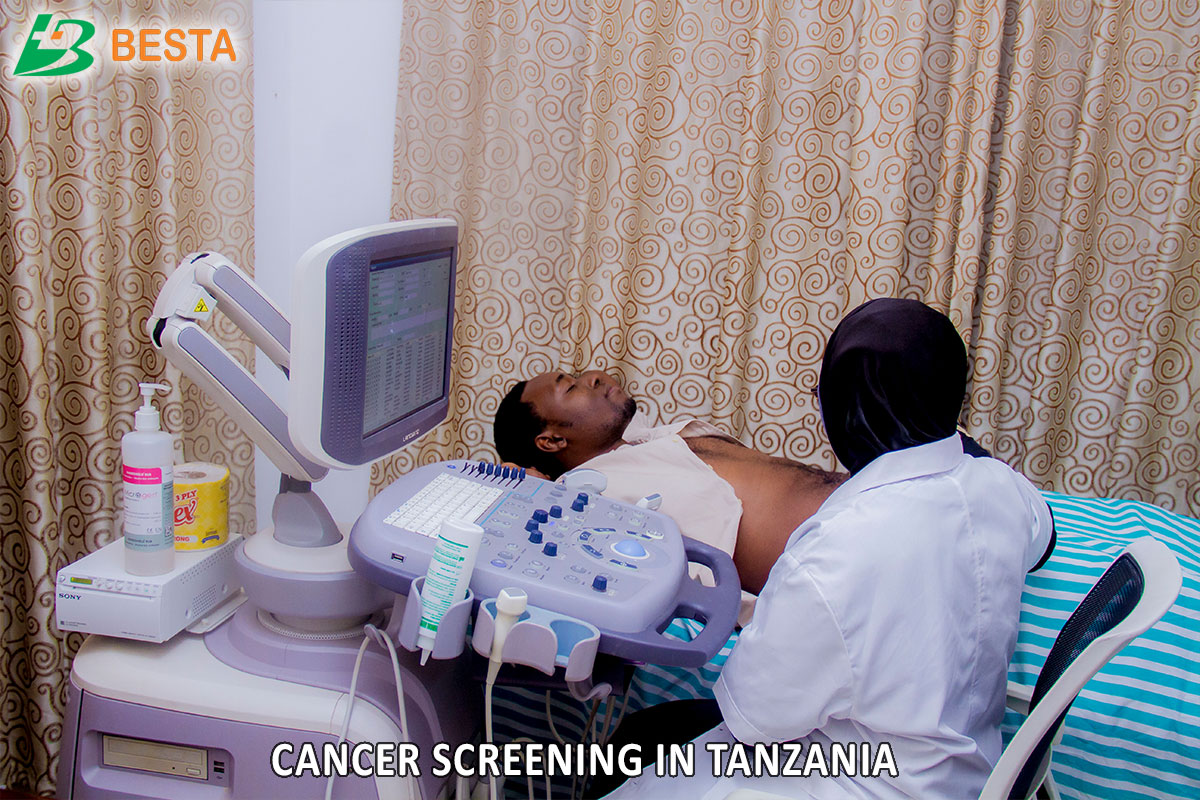
Besta Health Foundation takes cancer screening to where people already are, through mobile community outreaches held in underserved areas.
Three cancers are covered, chosen because each one is common in Tanzania and each one is treatable when caught early:
- Breast cancer — clinical breast examination, plus teaching women how to check themselves between visits
- Cervical cancer — screening for precancerous changes that can be treated long before cancer develops
- Prostate cancer — checks for men, a group that rarely presents for screening of any kind until symptoms force the issue
Every one of these services is free at the point of use. That matters more than it sounds. A cancer screening test that costs money screens the people who have money, and those are not the people dying of late-stage disease.
The Foundation has held more than five community cancer screening outreaches since it began. During the annual Breast Cancer Awareness Month campaign each October, BHF screened over 300 women, referring those with suspicious findings straight into further investigation and treatment.
That referral step is the part that makes screening worth doing. A cancer screening camp that finds an abnormality and then leaves the woman to sort out the next stage herself has done very little for her. Because BHF also runs patient care and support programmes — covering diagnostics, treatment subsidies, and transport allowances — a positive screening result leads somewhere.
Finding it is the first step. Getting the patient through what comes next is the rest of the work.
Awareness is the other half of the job
A cancer screening camp can only test the people who show up. Getting them to show up is a separate problem, and it is mostly a problem of information.
BHF’s awareness work has reached an estimated 8,000 community members across Tanzania. The Foundation marks World Cancer Day each February with awareness campaigns, advocacy events and community activities that have reached more than 3,000 people with information on prevention, early detection, treatment options and survivor support.
It has also distributed over 10,000 educational materials in both Kiswahili and English, covering:
- Cancer risk factors
- Warning signs to watch for
- Prevention strategies
- Where to go for care
Publishing in both languages is not a courtesy. A brochure someone cannot read is a brochure that changes nothing, and health information that only exists in English reaches the smallest and least at-risk slice of the population.
Two barriers get harder attention in this work. The first is fatalism — the belief that a cancer diagnosis is simply a death sentence, which makes testing feel pointless. The second is stigma, which keeps people from mentioning symptoms to anyone, including a doctor.
Both beliefs kill people who were treatable. Both are easier to shift in a community hall, with a nurse answering questions in Kiswahili, than in any clinic.
Survivors do that part best. When someone who was screened, treated and is now well says so out loud in their own community, it does more for turnout at the next camp than any poster.
Warning signs worth acting on early
Cancer screening catches what you cannot feel. Knowing the warning signs catches what you can.
None of the signs below means cancer. All of them mean see a health worker rather than wait.
| Cancer | Signs worth checking | Who should be screened |
|---|---|---|
| Breast | A lump or thickening, change in breast shape or size, skin dimpling, nipple discharge or inward turning | Women, with regular clinical checks and monthly self-examination |
| Cervical | Bleeding between periods or after sex, bleeding after menopause, unusual discharge, pelvic pain | WHO recommends screening women twice, by age 35 and again by 45 |
| Prostate | Difficulty passing urine, weak flow, passing urine often at night, blood in urine | Men from around age 50, or earlier with a family history |
Prevention reaches further back than cancer screening does. Almost all cervical cancer is caused by HPV, and Tanzania introduced HPV vaccination for schoolgirls in 2018, offering the vaccine to girls aged 9 to 14. A girl vaccinated today is a woman who will most likely never need cervical cancer treatment.
The World Health Organization’s global elimination strategy sets three targets for 2030, often called 90-70-90:
- 90% of girls fully vaccinated against HPV by age 15
- 70% of women screened with a high-performance test by 35, and again by 45
- 90% of women with precancer or cancer receiving the treatment they need
Community cancer screening outreaches are how the middle target gets met in practice, one village at a time.
Where the numbers stand and where they are going
Here is what the prevention and awareness programme has delivered so far.
| Prevention and awareness activity | Achieved since January 2025 |
|---|---|
| Community cancer screening outreaches held | 5+ |
| Women screened during Breast Cancer Awareness Month | 300+ |
| People reached on World Cancer Day | 3,000+ |
| Educational materials distributed in Kiswahili and English | 10,000+ |
| Community members reached overall | 8,000+ |
| Health workers, caregivers and survivors trained | 200+ |
Prevention and cancer screening account for an estimated 35% of the Foundation’s programme work, with community cancer screening valued at around TZS 50 million and awareness and educational materials at around TZS 120 million in services delivered.
The target for 2030 is considerably larger: 100,000+ people screened, survivor support groups in every region, and 1,000+ health workers trained.
Getting there needs more camps in more regions, and camps cost money — for test kits, for the clinical team, for transport, and for the follow-up care that makes a positive result useful rather than frightening.
You can help in three ways. Donate to fund a cancer screening camp in a community that has never had one. Partner with us if your organisation, hospital or company can host or co-fund an outreach. Or volunteer at a camp, where the work runs on people who show up.
If you have not been screened, the most useful thing you can do is book it. Contact us to find out when the next community outreach reaches your area.
Besta Health Foundation is a registered non-governmental organisation (Registration No. 00NGO/R/7951), established 3 January 2025 under the Non-Governmental Organizations Act, 2002. Head office: Tunisia Road, Ada Estate, Kinondoni, Dar es Salaam. P.O. Box 5596.
Sources: GLOBOCAN 2022 estimates for Tanzania · WHO cervical cancer fact sheet · WHO Africa on Tanzania’s HPV vaccination programme